
Traffic by itself does not generate revenue. A business can invest heavily in SEO, paid advertising, social campaigns, and content marketing, but if the user journey is fragmented, growth eventually stalls. Clicks alone are not enough. What drives sustainable revenue is a structured sales funnel strategy that guides users from initial interest to conversion and long-term retention.
This is where many companies struggle. They have landing pages, forms, campaigns, and automation tools, but they do not have a connected funnel system. Their WordPress or Shopify website operates more like a collection of isolated pages than a coordinated growth engine.
High-converting sales funnels work differently. They align messaging, behavioral data, automation, CRM integration, and conversion funnel optimization into one structured system designed to move users through the buying journey intentionally. When built correctly, sales funnels do more than increase conversions. They create predictability, scalability, and measurable revenue growth.
The Real Business Problem Behind Low-Converting Funnels
Most funnels fail long before the customer reaches the checkout page or sales call. The issue usually starts earlier in the journey when businesses fail to align traffic sources, user intent, and funnel progression.
A visitor arriving from a Google search has different expectations than someone clicking on a retargeting campaign. Likewise, a returning prospect who already interacted with your content should not receive the same messaging as a first-time visitor. Yet many businesses send every user into the same generic experience.
This disconnect creates friction throughout the funnel. CTAs feel premature, messaging lacks relevance, and users struggle to understand the next step. Marketing teams continue generating traffic, but conversion rates remain inconsistent because the funnel architecture itself is weak.
The problem is not necessarily WordPress or Shopify. Both platforms are capable of supporting sophisticated funnel systems. The real issue is that most companies never build the operational structure required for a true high-converting sales funnel.
Why Most Sales Funnels Fail on WordPress and Shopify
A common misconception is that installing funnel plugins or launching campaigns automatically creates an optimized funnel. In reality, even technically functional funnels often underperform because the strategy behind them is incomplete.
Funnels typically fail because:
- Funnel stages are not clearly defined
- CTAs are disconnected from user intent
- CRM systems are not integrated properly
- Behavioral tracking is limited or inconsistent
- Automation workflows operate independently
- Traffic is directed to generic landing pages
- Personalization is missing from the user experience
On WordPress websites, businesses often focus heavily on page design without mapping the broader funnel journey. On Shopify stores, brands tend to prioritize product pages and checkout optimization while neglecting post-click nurturing and lifecycle automation.
The platform itself is rarely the limitation. The limitation is the absence of a connected sales funnel strategy designed around how customers actually move through the buying process.
High-Converting Sales Funnels Work as Connected Growth Systems
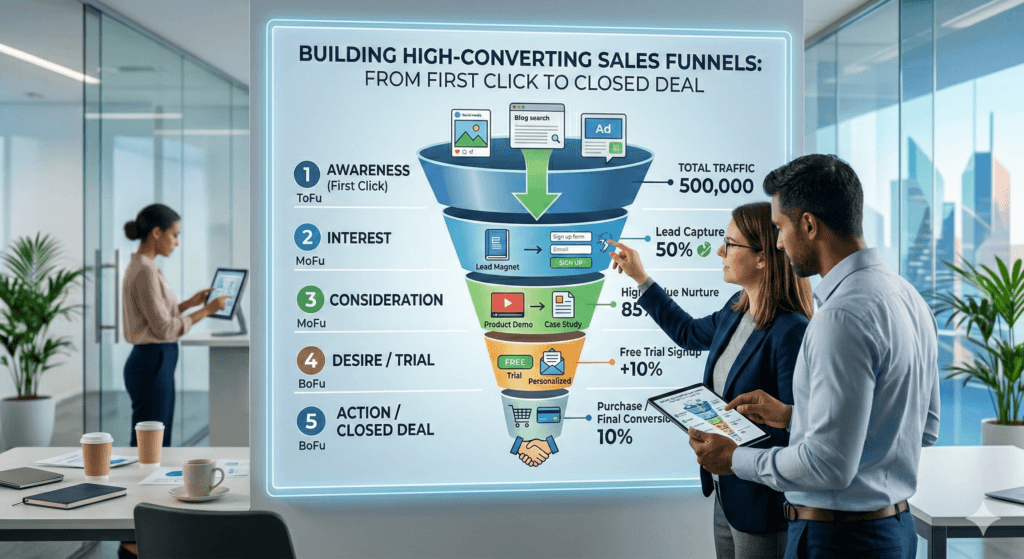
A high-converting sales funnel is not simply a sequence of pages. It is a coordinated system that guides users through progressive stages of awareness, consideration, decision-making, and retention.
Each stage requires different messaging, different automation triggers, different content, and different conversion goals.
At the top of the funnel, users need educational content and trust-building experiences. Mid-funnel prospects require stronger positioning, proof, and nurturing. High-intent users need frictionless paths to conversion supported by CRM integration, lead qualification, and personalized offers.
Without that structure, websites behave like static brochures. With a properly built conversion funnel optimization strategy, they become scalable growth systems that continuously improve how revenue is generated.
The Five Core Components of High-Converting Sales Funnels
Traffic Alignment and Intent Matching
Every effective sales funnel strategy begins with alignment between traffic source and landing experience.
Visitors coming from paid ads, organic search, email campaigns, or retargeting efforts all arrive with different expectations and levels of intent. High-converting funnels ensure that messaging, offers, and landing page structure reflect the context behind the click.
On WordPress, this often involves building custom landing page frameworks designed around audience segmentation and funnel stages. On Shopify, it typically means creating campaign-specific product flows and tailored shopping experiences.
Strong message alignment at this stage significantly improves conversion rates because users immediately feel they arrived in the right place.
Behavioral Tracking and Funnel Segmentation
Modern funnels improve when they adapt to user behavior.
Behavioral tracking allows businesses to monitor actions such as page engagement, pricing page visits, cart activity, product interest, resource downloads, and time on site. This data becomes the foundation for segmentation and funnel optimization.
Without behavioral visibility, funnels operate blindly. Businesses lose the ability to identify high-intent users, personalize experiences, or trigger automation based on meaningful engagement signals.
This is especially important for B2B sales funnel optimization where longer buying cycles require deeper insight into customer behavior before sales outreach occurs.
Automation and Lead Nurturing
Most funnels break immediately after the first conversion action.
A user downloads a resource or submits a form, but the follow-up process lacks structure. High-converting sales funnels avoid this by integrating automated sales funnels directly into the user journey.
This includes:
- Automated email nurturing
- SMS follow-up sequences
- Behavioral retargeting campaigns
- Objection-handling workflows
- Content progression paths
- Sales team alerts
On WordPress websites, this often requires CRM and marketing automation integration. In Shopify sales funnel environments, automation extends into transactional messaging, post-purchase sequences, upsell flows, and customer retention strategies.
Automation is what transforms a manual funnel into a scalable revenue system.
CRM Integration and Lead Qualification
Generating leads is only valuable if those leads are qualified properly.
Effective CRM integration allows businesses to score leads, track engagement, automate pipeline movement, and connect sales activity directly to customer behavior. Instead of passing raw inquiries to the sales team, the funnel delivers qualified opportunities supported by meaningful behavioral data.
This improves sales efficiency while also strengthening revenue attribution across the entire funnel.
For businesses investing in B2B sales funnel optimization, CRM integration becomes essential because it connects marketing performance directly to pipeline generation and closed revenue.
Personalization and Conversion Funnel Optimization
The strongest funnels are dynamic rather than static.
High-performing systems adapt based on funnel stage, previous interactions, traffic source, and behavioral signals. This may include personalized CTAs, returning visitor messaging, industry-specific landing paths, product recommendations, or automated upsell opportunities.
WordPress funnel strategy frameworks often support advanced content personalization through CMS flexibility and CRM integrations. Shopify sales funnel systems excel at dynamic product recommendations, cart optimization, subscription flows, and post-purchase automation.
When personalization is layered into the funnel correctly, conversion optimization becomes significantly more effective because the user experience feels aligned with customer intent instead of generic.
Ecommerce platforms for Funnel Strategy
Ecommerce platforms can support high-converting funnels but they excel differently.Some systems used for this are:
WordPress Funnels Work Best For:
- B2B lead generation
- Service-based businesses
- Long sales cycles
- Multi-touch nurture sequences
- Custom CRM integrations
Shopify Funnels Excel In:
- eCommerce conversion flows
- Cart optimization
- Subscription models
- Post-purchase upsells
- Customer lifetime value growth
The real difference isn’t the platform, it’s how well the funnel is architected within it.
The Revenue Impact of a Structured Funnel System
When high-converting sales funnels are implemented properly, the impact extends far beyond conversion rates.
Businesses typically experience:
- Lower customer acquisition costs
- Higher conversion efficiency
- Improved lead quality
- Increased average order value
- Better customer lifetime value
- Stronger revenue attribution
- Shorter sales cycles
Most importantly, structured funnels create predictability.
Predictable conversion systems allow businesses to scale marketing investments more confidently because revenue generation becomes measurable and repeatable. That operational consistency is what allows companies to grow sustainably rather than relying on isolated campaign performance.
Predictability creates scale.
Scale drives growth.
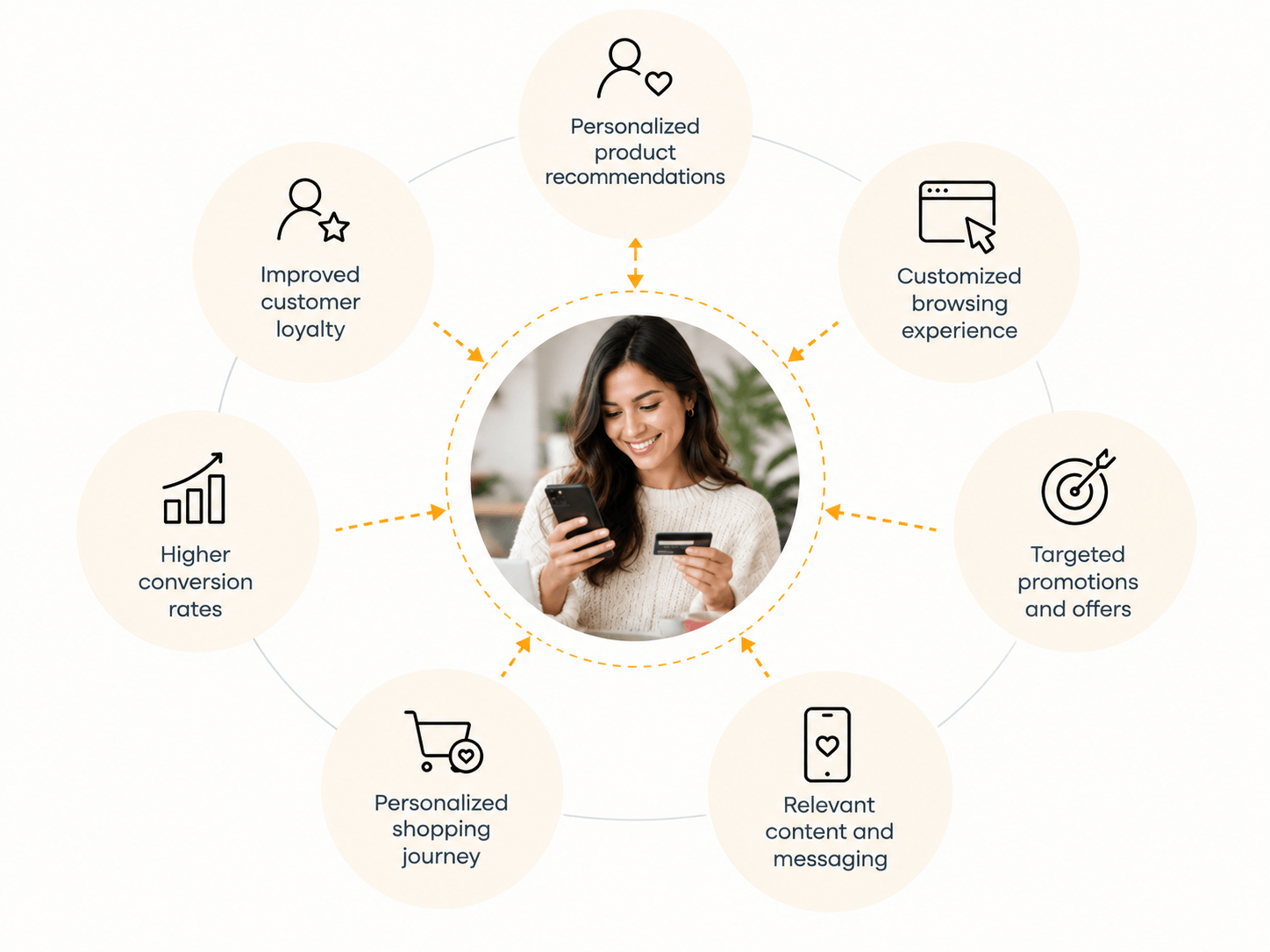
The Revenue Impact of a Structured Funnel
When properly built, high-converting funnels deliver measurable results.
Higher Conversion Rates
Lower Acquisition Costs
Shorter Sales Cycles
Increased Average Order Value
Improved Customer Lifetime Value
Clear Revenue Attribution
Most importantly, they create:
Predictability
Scale
Growth
Common Funnel Mistakes That Limit Growth
Even sophisticated companies often weaken performance by focusing too heavily on isolated tactics rather than the full system.
Some of the most common issues include:
- Overcomplicated funnel stages
- Generic CTAs across all traffic sources
- Poor mobile optimization
- Disconnected automation systems
- Lack of micro-conversion tracking
- Misalignment between marketing and sales teams
Funnels fail when businesses optimize individual components without strengthening the underlying strategy connecting them.
How Cultura Interactive Builds High-Converting Funnel Systems
At Cultura Interactive, we build high-converting sales funnels designed around measurable business outcomes, not just aesthetics or isolated campaigns.
Our approach combines:
- Sales funnel strategy
- Conversion funnel optimization
- Behavioral tracking
- CRM integration
- Personalized automation
- WordPress funnel strategy development
- Shopify sales funnel optimization
- Revenue attribution systems
We help businesses create connected growth infrastructures where traffic acquisition, automation, personalization, and conversion optimization work together as a unified system.
The goal is not simply to generate more leads. It is to create scalable funnel architectures that consistently move users from first click to closed deal.
Ready to Build a High-Converting Sales Funnel That Scales?
If your current website generates traffic but struggles to convert users consistently, the issue may not be your marketing campaigns. It may be the architecture behind your funnel.
Whether you operate a B2B WordPress website or a scaling Shopify store, your sales funnel determines how effectively traffic turns into revenue.
At Cultura Interactive, we design automated sales funnels that integrate CRM systems, behavioral tracking, personalization, and conversion optimization into one cohesive growth engine.
Schedule your Funnel Strategy Consultation today and discover how to build a high-converting sales funnel designed for scalable, measurable growth.