

Turn Your Shopify Store Into a Stronger Revenue System
Identify the Shopify constraints affecting customer progression,
operational control, and revenue performance.
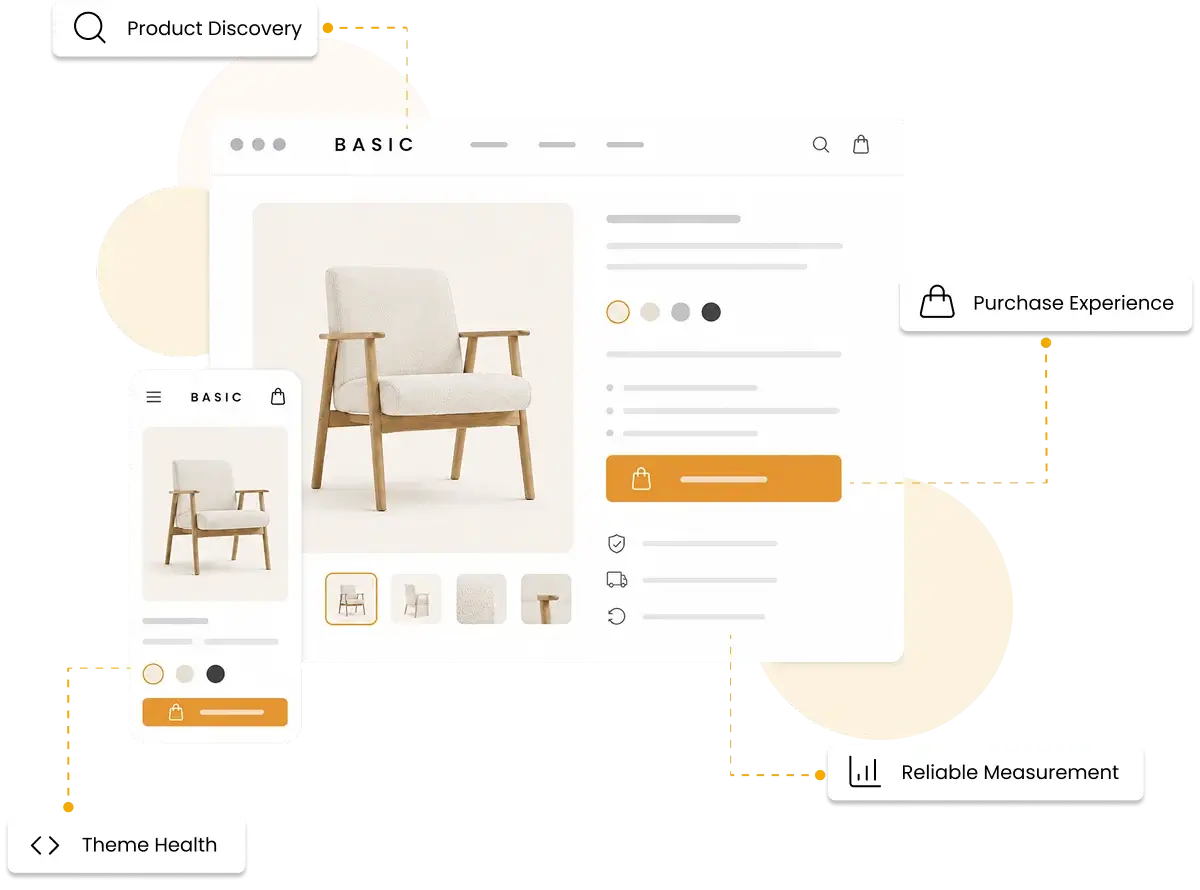
When a Working Shopify Store Stops Supporting Growth
A Shopify store can process orders while still making growth unnecessarily difficult.
Themes are modified, apps accumulate, integrations become fragile, and short-term
workarounds gradually shape the customer experience.
Navigation, search, filtering, and collection structure make it difficult for customers to find relevant products.
Incomplete product information, unclear options, subscription choices, promotions, or mobile interactions create uncertainty before purchase.
Overlapping apps, legacy code, third-party scripts, and fragile integrations make storefront changes slower, riskier, and more expensive.
Incomplete tracking and disconnected data prevent the team from distinguishing genuine customer friction from internal assumptions.
Product discovery
becomes harder
Navigation, search, filtering, and collection structure make it difficult for customers to find relevant products.
Buying decisions require
more effort
Incomplete product information, unclear options, subscription choices, promotions, or mobile interactions create uncertainty before purchase.
Technical complexity
restricts improvement
Overlapping apps, legacy code, third-party scripts, and fragile integrations make storefront changes slower, riskier, and more expensive.
Measurement fails to
explain performance
Incomplete tracking and disconnected data prevent the team from distinguishing genuine customer friction from internal assumptions.
Improve the Parts of Shopify That
Influence Revenue
Shopify optimization is not limited to increasing page speed or changing a theme. The opportunity is to
improve how customers discover products, evaluate their choices, complete purchases, and return—while
creating a more reliable platform for the business operating behind the storefront.
Clearer navigation, stronger onsite search, useful filtering, and purposeful collection merchandising help customers reach relevant products with less effort.
Better product-page hierarchy, education, options, reviews, subscription presentation, and purchase interfaces give customers the information and confidence needed to decide.
Theme performance, responsive behavior, accessibility, cart interactions, promotions, and third-party scripts all influence whether customer interest progresses toward purchase.
A maintainable theme, disciplined application ecosystem, reliable integrations, and flexible merchandising tools make improvements easier to implement without adding unnecessary complexity.
Accurate customer, product, order, and behavioral data helps the business identify meaningful constraints, prioritize opportunities, and evaluate what changes after implementation.
Reduce storefront and mobile friction
Improve technical and operational control
Build more reliable measurement
Make products easier to discover
Clearer navigation, stronger onsite search, useful filtering, and purposeful collection merchandising help customers reach relevant products with less effort.

Strengthen product evaluation
Better product-page hierarchy, education, options, reviews, subscription presentation, and purchase interfaces give customers the information and confidence needed to decide.

Reduce storefront and mobile friction
Theme performance, responsive behavior, accessibility, cart interactions, promotions, and third-party scripts all influence whether customer interest progresses toward purchase.

Improve technical and operational control
A maintainable theme, disciplined application ecosystem, reliable integrations, and flexible merchandising tools make improvements easier to implement without adding unnecessary complexity.

Build more reliable measurement
Accurate customer, product, order, and behavioral data helps the business identify meaningful constraints, prioritize opportunities, and evaluate what changes after implementation.

Connect Shopify
Improvements to the
Complete Revenue Journey
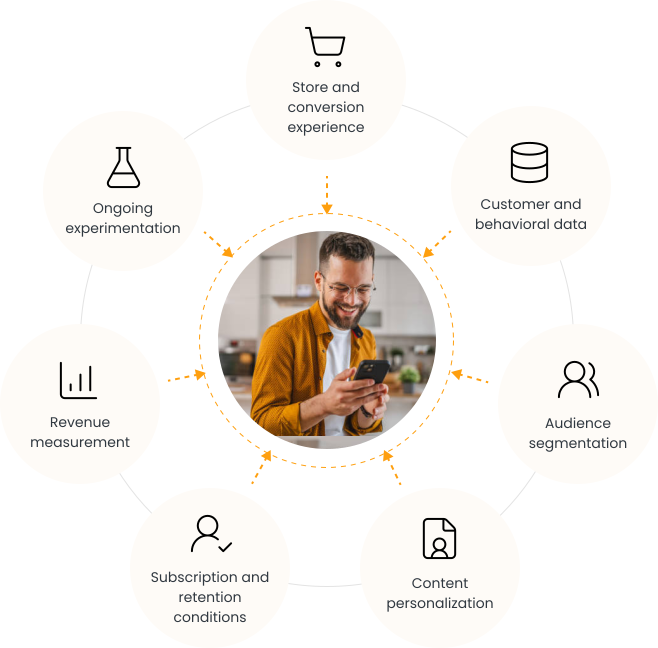
Shopify is one part of the system that turns traffic into sustainable revenue.
Storefront improvements can strengthen product discovery and conversion while creating a better foundation for content personalization, lifecycle automation, subscription retention, testing, and measurement
From Shopify Diagnosis to Measurable Improvement
identify the constraints that matter most before recommending isolated fixes, major
redevelopment, or a complete redesign.
Cultura evaluates the customer journey, behavioral evidence, storefront experience, theme environment, applications, integrations, merchandising requirements, and measurement reliability.
Recommendations are organized according to customer impact, expected commercial value, implementation effort, technical risk, dependencies, and measurability.
This produces a focused roadmap instead of an undifferentiated list of requested changes.
Cultura directly provides the strategy, UX/UI design, Shopify development, application and integration configuration, analytics implementation, testing, and quality assurance required for the approved scope.
Following implementation, behavioral, commercial, and technical evidence is used to evaluate changes and identify the next priorities within an ongoing Revenue Optimization program.
1. Diagnose the constraints
Cultura evaluates the customer journey, behavioral evidence, storefront experience, theme environment, applications, integrations, merchandising requirements, and measurement reliability.
2. Prioritize the opportunities
Recommendations are organized according to customer impact, expected commercial value, implementation effort, technical risk, dependencies, and measurability.
This produces a focused roadmap instead of an undifferentiated list of requested changes.
3. Design and implement the improvements
Cultura directly provides the strategy, UX/UI design, Shopify development, application and integration configuration, analytics implementation, testing, and quality assurance required for the approved scope.
4. Measure and optimize
Following implementation, behavioral, commercial, and technical evidence is used to evaluate changes and identify the next priorities within an ongoing Revenue Optimization program.
Improve the Storefront, Platform,
and Purchase Experience
The final scope depends on the diagnostic findings and the priorities approved for
implementation. Shopify Optimization may address the following interconnected areas.
Customer Experience
Help customers find, evaluate, and purchase.
Technical Foundation
Create a reliable storefront and data environment.
Advanced Evolution
Make larger changes only when justified.
Selected Shopify Experience
Experience across Shopify and Shopify Plus storefronts, subscriptions,
product discovery, migrations, integrations, and custom development.

Shopify Plus Ecosystem
Supporting a Complex
Shopify Plus Ecosystem
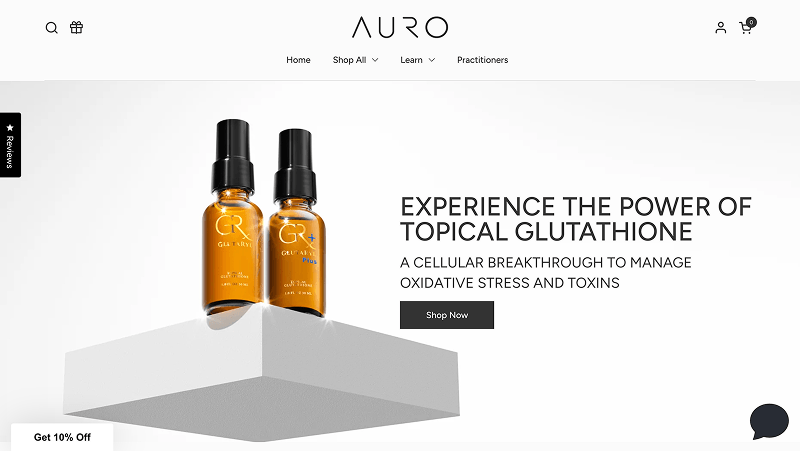
AuroWellness represents experience involving Shopify Plus
applications, subscription technology, reviews, affiliate
requirements, integrations, and technical troubleshooting.
Build a More Effective Revenue Journey
Explore practical guidance on customer behavior, product-page performance, and
turning the store into a more productive revenue channel.
FAQ
1. What is Shopify optimization?
Shopify optimization is the process of improving how a Shopify store performs for customers and the business operating it. It may address storefront UX, theme architecture, speed, applications, integrations, navigation, search, collections, product pages, cart, checkout, analytics, merchandising, and maintainability.
Cultura treats these areas as connected parts of one revenue system. The engagement begins with a diagnostic that identifies the most important constraints and establishes a prioritized implementation roadmap.
2. Does Cultura optimize both Shopify and Shopify Plus stores?
Yes. Cultura works with Shopify and Shopify Plus stores.
The core methodology remains consistent: diagnose the customer and commercial problem, evaluate the technical environment, prioritize opportunities, implement approved improvements, and measure what changes.
Shopify Plus engagements may involve additional considerations such as checkout extensibility, Shopify Functions, B2B, Markets, complex integrations, governance, and higher-volume operations.
3. Is Cultura a Shopify Plus Partner?
Cultura is identified as a Shopify Plus Partner.
Verification required before publication: Confirm that the designation remains current and that Cultura may use the corresponding terminology and badge under Shopify’s current brand requirements.
4. How does a Shopify Optimization engagement begin?
Every engagement begins with a defined diagnostic. Cultura evaluates the commercial objectives, customer journey, behavioral evidence, storefront experience, theme environment, applications, integrations, analytics, and relevant operational constraints.
Recommendations are then prioritized according to customer impact, expected commercial value, implementation effort, technical risk, dependencies, and measurement requirements.
5. Does Shopify Optimization become an ongoing program?
It can. The defined diagnostic establishes what should be addressed and in what order. Cultura can implement the approved priorities and transition the engagement into an ongoing Revenue Optimization program.
The ongoing program provides a framework for continuing to analyze customer behavior, improve the storefront, support merchandising requirements, address technical constraints, and measure performance over time.
6. Does Cultura implement its recommendations?
Yes. Cultura can provide the strategy, UX/UI design, Shopify development, application configuration, integration work, analytics implementation, testing, and quality assurance required to execute approved recommendations.
The final scope and implementation sequence are established after the diagnostic.
7. Is Shopify optimization the same as conversion-rate optimization?
No, although the services overlap.
Shopify Optimization focuses on the platform-specific conditions affecting performance, including themes, applications, integrations, Shopify functionality, storefront architecture, merchandising tools, and relevant Shopify Plus capabilities.
eCommerce Conversion Rate Optimization focuses more deeply on behavioral research, funnel analysis, experimentation, and systematic conversion improvement across platforms. The services can work together when the opportunity requires both.
8. Can Cultura improve our current Shopify theme?
Yes. Cultura can assess and improve an existing theme when its underlying architecture remains appropriate for the business.
Potential work includes performance remediation, template improvements, section and block development, mobile usability, accessibility, component consistency, technical-debt reduction, merchandising flexibility, and custom functionality.
If the existing theme cannot reasonably support the required improvements, Cultura may recommend a larger rebuild or complete redesign.
9. Does Cultura provide complete Shopify redesigns?
Yes. Cultura offers complete Shopify redesigns when the business needs a substantial change to its customer experience, brand presentation, information architecture, merchandising capabilities, or technical foundation.
A redesign is recommended when diagnostic evidence and business requirements justify it. It is not treated as the automatic answer to every performance problem.
10. Can Cultura migrate a business to Shopify?
Yes. Shopify migrations are available as a supporting capability.
The scope may include discovery, catalog and data planning, information architecture, UX/UI design, theme development, application configuration, integrations, redirects, analytics continuity, quality assurance, and launch requirements.
Because migration complexity varies significantly, Cultura defines the appropriate scope through discovery and planning.
11. Can Cultura identify applications that are slowing down or complicating our store?
Yes. Cultura can evaluate front-end scripts, overlapping functionality, integration dependencies, recurring costs, abandoned code, and the operational contribution of each application.
An application should not be removed solely because it adds code. Decisions must also consider customer value, business requirements, data dependencies, replacement risk, and maintainability.
12. Does Cultura provide Shopify speed optimization?
Yes, but speed is only one dimension of Shopify Optimization.
Cultura evaluates theme code, applications, third-party scripts, media, interaction behavior, Core Web Vitals, and other merchant-controlled factors. Recommendations balance storefront performance with the functionality the business needs to operate effectively.
13. Can Cultura optimize navigation, collections, search, and product pages?
Yes. Product discovery and product evaluation are central parts of the service.
Cultura can improve navigation architecture, mobile menus, collection organization, filtering, sorting, onsite search, product cards, merchandising, product-page hierarchy, variant selection, reviews, product education, and purchase interfaces.
14. Can Cultura help with Shopify Plus checkout extensibility?
Yes. Shopify Plus checkout extensibility is evaluated case by case.
The appropriate scope depends on platform eligibility, the current checkout configuration, required applications and integrations, customer needs, operational requirements, implementation risk, and expected commercial value.
15. Does Cultura work with Shopify subscription stores?
Yes. Cultura has experience with Shopify and Shopify Plus subscription businesses and connected subscription technologies.
Shopify Optimization can address subscription presentation and purchase friction within the storefront. Deeper work involving payment recovery, subscriber portals, cancellation experiences, retention communications, and churn reduction belongs within Cultura’s Subscription Retention service.
Let's unlock your store's full revenue potential.
Get a custom audit and see exactly where you’re losing
revenue—and how to fix it.
- Revenue leak breakdown
- Conversion & retention opportunities
- Personalization roadmap
- Priority action plan
- Estimated revenue impact