

Revenue Opportunities
with Synerise
Customer Intelligence
Evaluate platform fit, data readiness, priority use cases, and
implementation requirements.
Synerise connects customer and behavioral data with segmentation, predictive churn insights, content personalization, product discovery, and lifecycle communication.

Why Advanced Platforms
Become Underused
Synerise can connect customer intelligence with experiences across the
commerce lifecycle. Its value, however, depends on reliable data, carefully
selected use cases, direct implementation, and clear operational ownership.
Customer intelligence creates value only when it improves content, recommendations, search, campaigns, and automated journeys.
Fragmented customer data and technology
Fragmented customer data limits understanding and increases technology complexity. Synerise can consolidate relevant intelligence and coordinate overlapping tools.
Too many possible use cases
Activating everything at once increases complexity. Priorities should reflect revenue value, customer impact, data readiness, and implementation effort.
Disconnected intelligence and execution
Customer intelligence creates value only when it improves content, recommendations, search, campaigns, and automated journeys.
Missing operational ownership
Without active management and clear ownership, implementation stalls before valuable use cases are activated.
Where Synerise Can Improve the
Commerce Lifecycle
Connect behavioral, transactional, product, subscription, consent, and campaign data to improve customer identification and support more meaningful audience development.
Adapt content and customer experiences according to relevant behavior, interests, lifecycle conditions, or commercial priorities. Dynamic Content can connect customer intelligence with the experiences customers encounter throughout the storefront.
Use behavioral signals, product relationships, and catalog data to support relevant product recommendations and AI-assisted search experiences.
Connect customer conditions with automated email and SMS journeys, promotional broadcasts, audience-specific messaging, and personalized creative.
Use applicable segmentation and predictive capabilities to recognize purchase intent, product affinity, customer value, re-engagement opportunities, or potential churn conditions.
Where appropriate, consolidate customer-data, personalization, recommendation, search, email, SMS, and automation requirements within a more coordinated platform environment. The objective is not simply to use fewer tools, but to reduce fragmentation and improve how data becomes action.
Build a more actionable customer view
Connect behavioral, transactional, product, subscription, consent, and campaign data to improve customer identification and support more meaningful audience development.

Personalize the storefront experience
Adapt content and customer experiences according to relevant behavior, interests, lifecycle conditions, or commercial priorities. Dynamic Content can connect customer intelligence with the experiences customers encounter throughout the storefront.

Improve product discovery
Use behavioral signals, product relationships, and catalog data to support relevant product recommendations and AI-assisted search experiences.

Coordinate lifecycle communication
Connect customer conditions with automated email and SMS journeys, promotional broadcasts, audience-specific messaging, and personalized creative.

Identify changing customer conditions
Use applicable segmentation and predictive capabilities to recognize purchase intent, product affinity, customer value, re-engagement opportunities, or potential churn conditions.

Simplify customer-experience activation
Where appropriate, consolidate customer-data, personalization, recommendation, search, email, SMS, and automation requirements within a more coordinated platform environment. The objective is not simply to use fewer tools, but to reduce fragmentation and improve how data becomes action.

Connect Intelligence With
Customer Experience
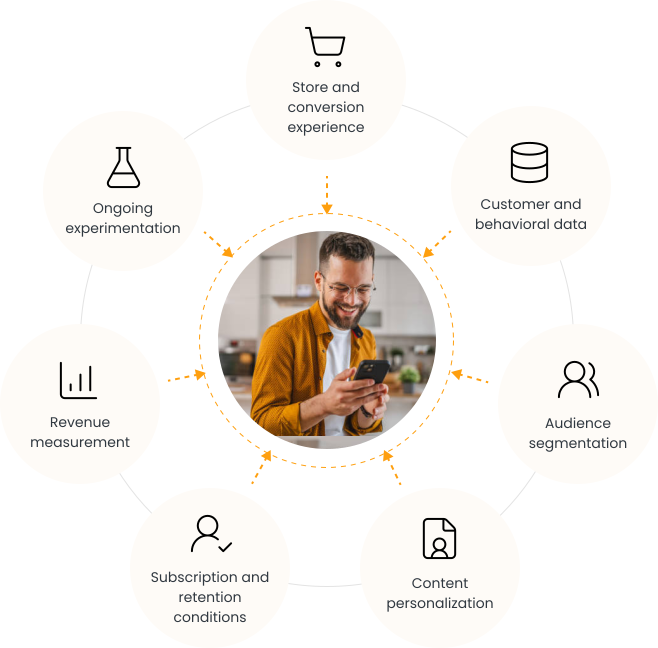
Synerise is a technology within Cultura’s broader Revenue Optimization System. The platform supplies customer intelligence and activation capabilities; the Revenue Optimization program determines where and how those capabilities should influence the commerce experience.
Build the Foundation for Customer Intelligence and Activation
The implementation scope is determined by the organization’s approved use cases. It may include
the following capability areas without requiring every capability to be activated simultaneously.
Configure behavioral events, customer profiles, identity, transactions, consent, product interactions, subscription information, and campaign engagement.
Develop audiences using behavior, purchases, affinities, lifecycle conditions, customer value, and applicable predictive capabilities.
Connect Synerise with Shopify, Shopify Plus, WooCommerce, and approved business systems through APIs, feeds, webhooks, imports, or custom integrations.
Implement Dynamic Content and audience-specific storefront experiences.
Configure AI-supported recommendations, search, automated customer journeys, promotional email and SMS, and personalized creative.
The work may include catalog preparation, templates, configuration, quality assurance, and measurement requirements.
Activate subscription and commerce data for approved personalization, communication, and customer-intelligence use cases.
Web push, mobile-app activity, offline information, and point-of-sale data may be included when relevant data and technical access are available.
1. Data & Customer Intelligence
Configure behavioral events, customer profiles, identity, transactions, consent, product interactions, subscription information, and campaign engagement.
Develop audiences using behavior, purchases, affinities, lifecycle conditions, customer value, and applicable predictive capabilities.
2. Commerce Integration & Personalization
Connect Synerise with Shopify, Shopify Plus, WooCommerce, and approved business systems through APIs, feeds, webhooks, imports, or custom integrations.
Implement Dynamic Content and audience-specific storefront experiences.
3. Product Discovery & Lifecycle Activation
Configure AI-supported recommendations, search, automated customer journeys, promotional email and SMS, and personalized creative.
The work may include catalog preparation, templates, configuration, quality assurance, and measurement requirements.
4. Subscription & Additional Channels
Activate subscription and commerce data for approved personalization, communication, and customer-intelligence use cases.
Web push, mobile-app activity, offline information, and point-of-sale data may be included when relevant data and technical access are available.
Experience, Readiness,
and Platform Fit
Synerise fit is not determined by a published traffic or revenue threshold.
Evaluation considers the organization’s available data, customer activity, priority use cases, technical environment, integration requirements, and operational commitment.
It examines whether relevant data from eCommerce platforms, custom APIs, and other business systems can be connected to strengthen customer analysis, enrich customer profiles and support the proposed use cases.
Data Readiness
Customer identification, consent, behavioral, product, transaction, and subscription data.
Commercial Opportunities
Priority personalization, automation, customer-experience, and platform-consolidation opportunities.
Technical Fit
Existing technology, required integrations, storefront requirements, measurement, and dependencies.
Implementation Readiness
Operational commitment, creative requirements, available resources, and the appropriate implementation sequence.
Explore Customer Intelligence and Personalization
Continue exploring how customer data, personalization, automation, and product discovery
contribute to a more coordinated eCommerce Revenue Optimization System.
FAQ
1. What does a Synerise implementation include?
The scope depends on the organization’s objectives, data environment, commerce architecture, and priority use cases. It can include platform evaluation, license resale, behavioral-data architecture, tracking, identity configuration, eCommerce integrations, catalogs, segmentation, recommendations, search, Dynamic Content, predictive capabilities, email and SMS, automated journeys, promotional broadcasts, creative production, quality assurance, and activation.
2. Does Synerise Implementation begin with a separate diagnostic?
No. Cultura does not require a predefined Synerise diagnostic as the first engagement. The implementation begins by establishing business objectives, available data, customer conditions, technical requirements, intended experiences, and priority use cases. Those findings determine the architecture, scope, and implementation sequence.
3. Can Cultura help determine whether Synerise is the right platform?
Yes. Cultura participates in platform evaluation and selection. We assess customer activity, available data, the commerce environment, intended channels, personalization requirements, priority use cases, technical dependencies, existing technology, and organizational readiness.
4. Can Cultura provide the Synerise license?
Yes. Cultura resells the Synerise license and provides the corresponding implementation services.
5. Is there a minimum traffic or revenue requirement?
Cultura does not publish a minimum website-traffic or revenue requirement for Synerise Implementation. Platform fit is evaluated according to customer activity, available data, intended use cases, implementation complexity, technical requirements, and the organization’s ability to support the planned system.
6. Does Cultura implement the technical and creative work directly?
Yes. Cultura directly performs the agreed configuration, integration, storefront development, campaign production, creative work, and quality assurance. When a specialized predictive or platform requirement benefits from Synerise’s direct involvement, Cultura coordinates that work within the implementation.
7. Can Cultura work with an existing Synerise environment?
Yes. Cultura can evaluate an existing environment to identify issues involving data, tracking, customer identity, catalogs, audiences, journeys, recommendations, search, Dynamic Content, integrations, or unfinished implementation requirements.
Approved improvements are completed through the applicable implementation scope or the relevant discipline within Cultura’s broader Revenue Optimization program. They are not sold as a separate service called Synerise Optimization.
8. What happens after the Synerise implementation is completed?
Subsequent work is organized under the appropriate area of Cultura’s Revenue Optimization program. Depending on the priorities involved, that may include eCommerce CRO, personalization, lifecycle automation, subscription retention, Shopify Optimization, or WooCommerce Optimization.
There is no separate ongoing Synerise Optimization or Development Support service.
9. Does Cultura manage email and SMS within Synerise?
Yes. Cultura can configure and manage automated email and SMS journeys and promotional broadcasts within Synerise. The approved scope may include strategy, segmentation, copywriting, design, templates, personalized creative, Dynamic Content, configuration, quality assurance, and delivery coordination.
10. Can Cultura implement recommendations, search, and predictive capabilities?
Cultura can configure and integrate AI-supported product recommendations and search experiences, including catalog preparation, placement planning, interface development, configuration, and validation.
Applicable predictive capabilities can be configured when supported by the use case and available data. Specialized advanced-model requirements may be coordinated with Synerise.
11. Can Synerise personalize the website as well as email and SMS?
Yes. Synerise can support Dynamic Content, audience-specific storefront experiences, product recommendations, search, email, SMS, and other relevant channels.
Cultura determines which experiences support the approved commercial objectives and directly implements the necessary strategy, content, creative, configuration, and storefront work.
12. Does Cultura implement Synerise for Shopify and Shopify Plus?
Cultura can implement Synerise within Shopify and Shopify Plus environments, including relevant data collection, storefront experiences, product discovery, campaign activation, and approved custom integration work.
13. Can Synerise be implemented with WooCommerce?
Yes. Cultura can implement the tracking, customer data, transaction data, catalogs, storefront experiences, and custom integrations required to connect Synerise with WooCommerce.
Cultura has also completed a custom integration that retrieved and coordinated subscription data from WooCommerce and Recurly for use in Synerise.
14. Can Cultura connect Synerise with subscription or custom business systems?
Yes. When an approved eCommerce use case requires information from another system, Cultura can evaluate the available APIs, feeds, webhooks, imports, data structures, permissions, and security requirements.
Cultura can develop the required custom integration when the approved architecture cannot be supported adequately by an existing connection.
15. Can Cultura migrate an existing email program to Synerise?
Cultura can evaluate the migration of customer data, consent records, audiences, templates, automations, and associated integrations from an existing platform.
The transferable scope depends on platform capabilities, API access, historical-data requirements, data quality, and account complexity.
Let's unlock your store's full revenue potential.
Get a custom audit and see exactly where you’re losing
revenue—and how to fix it.
- Revenue leak breakdown
- Conversion & retention opportunities
- Personalization roadmap
- Priority action plan
- Estimated revenue impact