

Reduce Preventable Churn and Protect Recurring Revenue
Discover where subscriber friction and preventable revenue loss
may be limiting growth.

Subscriber Growth Can Hide
Recurring-Revenue Loss
A growing subscriber count can still conceal early cancellations, difficult account experiences, and unresolved payment failures.
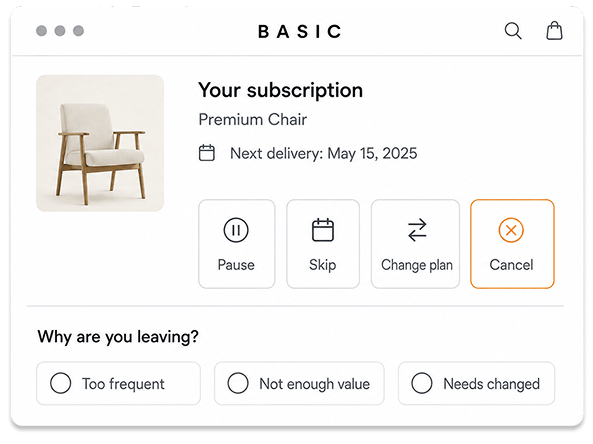
Voluntary churn
The product, value, timing, price, service, or subscription experience no longer meets their needs.
Involuntary churn
The customer may want to stay, but an expired card, billing issue, or failed payment prevents renewal.

Protect Revenue Across the Subscriber Lifecycle
Shopify optimization is not limited to increasing page speed or changing a theme. The opportunity is to
improve how customers discover products, evaluate their choices, complete purchases, and return—while
creating a more reliable platform for the business operating behind the storefront.
Clear onboarding, expectation setting, product guidance, and timely communication help customers understand the value of the subscription before uncertainty becomes dissatisfaction.
Subscribers’ needs change. Better account and portal experiences can give customers practical ways to adjust deliveries, products, schedules, or plans without creating unnecessary friction.
Cancellation must remain clear and respectful. Relevant alternatives may preserve a relationship, while accurate cancellation feedback helps expose problems that the business needs to address.
Expired cards, failed payments, billing issues, and disconnected recovery processes can end subscriptions customers intended to maintain. Coordinated dunning, communication, technology, and payment-recovery processes can address this form of involuntary churn.
Different subscribers require different interventions. Segmentation, lifecycle communication, content personalization, churn-risk indicators, feedback, win-back, and reactivation can make the experience more relevant to each customer’s condition.
Not every cancellation can or should be prevented. The objective is to identify preventable loss, improve the relationship where appropriate, and learn from the customers who still choose to leave.
Recover unintended revenue loss
Respond to subscriber behavior
Strengthen early subscriber value
Clear onboarding, expectation setting, product guidance, and timely communication help customers understand the value of the subscription before uncertainty becomes dissatisfaction.

Make subscriptions easier to manage
Subscribers’ needs change. Better account and portal experiences can give customers practical ways to adjust deliveries, products, schedules, or plans without creating unnecessary friction.
Cancellation must remain clear and respectful. Relevant alternatives may preserve a relationship, while accurate cancellation feedback helps expose problems that the business needs to address.

Recover unintended revenue loss
Expired cards, failed payments, billing issues, and disconnected recovery processes can end subscriptions customers intended to maintain. Coordinated dunning, communication, technology, and payment-recovery processes can address this form of involuntary churn.

Respond to subscriber behavior
Different subscribers require different interventions. Segmentation, lifecycle communication, content personalization, churn-risk indicators, feedback, win-back, and reactivation can make the experience more relevant to each customer’s condition.
Not every cancellation can or should be prevented. The objective is to identify preventable loss, improve the relationship where appropriate, and learn from the customers who still choose to leave.

Retention Depends on the
Entire Revenue System
Subscription churn is rarely isolated from the rest of the customer experience. It can reflect how the subscription was presented, what the customer expected, how effectively value was established, and how easily the relationship can be managed.

From Evidence to Implemented
Improvement
Cultura brings research, strategy, UX, development, and measurement together around a shared commercial objective. The process follows the evidence rather than a predetermined CRO checklist.
Review available subscription, billing, customer, behavioral, campaign, and revenue data to establish a baseline, identify meaningful gaps, and distinguish broad churn symptoms from specific subscriber conditions.
Examine onboarding, recurring orders, account management, billing events, support interactions, cancellation, and reactivation. This reveals friction that an aggregate churn rate cannot explain.
Separate voluntary and involuntary churn, compare relevant subscriber cohorts, and rank opportunities according to potential revenue significance, customer impact, feasibility, and data reliability.
Cultura develops the strategy and directly implements approved work across subscriber experiences, platform configuration, integrations, lifecycle communication, payment recovery, copy, creative, development, and quality assurance.
Monitor subscriber behavior, churn conditions, recovery performance, journey effectiveness, and experience friction. The findings guide continued testing and improvement through the broader Revenue Optimization program.
Subscription Retention can begin as a defined diagnostic or implementation project. The initial engagement establishes the priorities or infrastructure required for ongoing optimization.
1. Diagnose the revenue loss
Review available subscription, billing, customer, behavioral, campaign, and revenue data to establish a baseline, identify meaningful gaps, and distinguish broad churn symptoms from specific subscriber conditions.
2. Review the subscriber journey
Examine onboarding, recurring orders, account management, billing events, support interactions, cancellation, and reactivation. This reveals friction that an aggregate churn rate cannot explain.
3. Prioritize preventable opportunities
Separate voluntary and involuntary churn, compare relevant subscriber cohorts, and rank opportunities according to potential revenue significance, customer impact, feasibility, and data reliability.
4. Design and implement the improvements
Cultura develops the strategy and directly implements approved work across subscriber experiences, platform configuration, integrations, lifecycle communication, payment recovery, copy, creative, development, and quality assurance.
5. Measure and optimize
Monitor subscriber behavior, churn conditions, recovery performance, journey effectiveness, and experience friction. The findings guide continued testing and improvement through the broader Revenue Optimization program.
Improve the Experiences That
Influence Retention
The appropriate scope depends on the subscription model, customer journey,
technology, available data, and reasons subscribers leave. Cultura brings the relevant
work together rather than treating each intervention as an isolated project.
Subscriber experience
Improve onboarding, account management, subscription options, cancellation, and reactivation.
Measurement and analysis
Analyze churn by cause, cohort, tenure, product, plan, and payment condition to prioritize action.
Lifecycle communication and personalization
Create segmented, event-based journeys that address churn risk, feedback, win-back, and reactivation.
Development and integration
Implement the storefront, portal, subscription, data, and integration work required by the strategy.
Payment recovery
Build and continuously improve dunning, recovery communications, tools, and integrations.
Built for Shopify, Shopify Plus, and WooCommerce subscription
businesses—without assuming the existing platform must be replaced.
Evaluate the Opportunities
That Matter Most
The Revenue Opportunity Assessment establishes whether the most important retention opportunities relate to subscriber experience, voluntary churn, payment failure, communication, technology, data, or a combination of these conditions.
Why are subscribers leaving?
- Churn
- Payment failure
- Cancellation feedback
Where does friction appear?
- Onboarding
- Account management
- Communication
What limits improvement?
- Data
- Technology
- Integrations
Subscription Retention Insights
Explore the customer, payment, and experience conditions that influence recurring-revenue performance.
FAQ
1. What is eCommerce subscription retention?
eCommerce subscription retention is the coordinated effort to help valuable subscribers continue their relationship with a business while the subscription remains useful to them.
It may involve onboarding, account management, delivery flexibility, content personalization, payment recovery, cancellation alternatives, customer feedback, reactivation, analytics, and continuous experience improvement. Cultura treats these areas as parts of a connected Revenue Optimization System rather than isolated tactics.
2. What is the difference between voluntary and involuntary subscription churn?
Voluntary churn occurs when a subscriber intentionally cancels because of factors such as value, product fit, price, delivery timing, service, changing needs, or the subscription experience.
Involuntary churn occurs when the subscription ends because payment cannot be completed, even though the customer may have intended to remain subscribed. Both affect recurring revenue, but each requires different data, technology, communication, and intervention.
3. How does Cultura identify why subscribers are canceling?
Cultura reviews available subscription, billing, customer, behavioral, campaign, and revenue data. The evaluation may also examine subscriber journeys, account-management experiences, cancellation reasons, support interactions, feedback, introductory offers, tenure, acquisition sources, and subscriber cohorts.
The purpose is to move beyond one overall churn rate and identify which losses appear preventable and where improvement may have the greatest value.
4. Can Cultura help with failed subscription payments?
Yes. Cultura can design and configure dunning programs, help evaluate payment-recovery tools, implement relevant integrations, create recovery communication, and manage ongoing recovery optimization.
The recommended approach depends on the subscription platform, payment environment, available data, and existing recovery process.
5. Can Cultura improve our subscriber portal and cancellation experience?
Yes. Cultura designs and develops subscriber portals, cancellation flows, and relevant subscription-management experiences.
The objective is not to make cancellation impossible. It is to make the subscription easier to manage, present appropriate alternatives, collect useful feedback, and provide a respectful experience when a customer still chooses to leave.
6. Do we need to change subscription platforms?
Not necessarily. Cultura first evaluates whether the principal problems relate to strategy, configuration, integrations, communication, experience design, data, or the platform itself.
A platform change should be recommended only when its expected value justifies the technical, operational, and customer-experience consequences.
7. Is Subscription Retention different from Lifecycle Marketing Automation?
Yes, although the services work closely together.
Lifecycle Marketing Automation addresses communication across the broader customer relationship, including acquisition, conversion, post-purchase, re-engagement, and other lifecycle conditions.
Subscription Retention focuses more deeply on recurring value, churn risk, payment recovery, subscriber controls, cancellation, and reactivation.
8. Is Subscription Retention a one-time project or an ongoing program?
It can begin as a defined diagnostic or implementation project. That initial engagement may identify the most important opportunities or establish the necessary retention infrastructure.
Because subscriber behavior and business conditions continue to change, the initial work can become the foundation for an ongoing Revenue Optimization program focused on measurement, testing, and continuous improvement.
9. Does Cultura directly implement the recommended work?
Yes. Cultura can directly implement approved experience, development, configuration, integration, lifecycle, payment-recovery, creative, and measurement work included within the agreed scope.
This connects the retention strategy to practical execution without requiring the client to coordinate separate strategic and implementation teams.
10. Do we need a minimum number of subscribers or a minimum traffic level?
Cultura does not apply a universal qualification threshold. Each subscription business has different economics, technology, data, and operational maturity.
Subscriber volume and data quality affect what can be analyzed and tested reliably. Cultura evaluates those conditions during the initial conversation and recommends a scope appropriate to the available opportunity.
11. Which subscription metrics should an eCommerce business track?
Relevant metrics may include voluntary and involuntary churn, retention by cohort, subscriber tenure, failed-payment recovery, pauses, skips, cancellations, reactivations, subscriber lifetime value, recurring-revenue movement, plan performance, and cancellation reasons.
The appropriate framework depends on the subscription model. A single aggregate churn rate rarely provides enough information to prioritize improvements.
12. Can Cultura guarantee a specific reduction in churn?
No responsible retention program should guarantee a universal reduction.
Results depend on product value, customer expectations, acquisition quality, pricing, fulfillment, service, subscription design, data quality, implementation, and the business’s willingness to address underlying problems. Cultura identifies and prioritizes opportunities, implements approved improvements, and measures their effect without relying on unsupported promises.
13. What happens during a Revenue Opportunity Assessment?
The assessment begins with the subscription model, customer journey, business priorities, current technology, available data, and known retention concerns.
Cultura then identifies where recurring-revenue leakage or subscriber friction may exist and determines which experience, payment-recovery, lifecycle, analytical, or technical opportunities warrant deeper evaluation.
Let's unlock your store's full revenue potential.
Get a custom audit and see exactly where you’re losing
revenue—and how to fix it.
- Revenue leak breakdown
- Conversion & retention opportunities
- Personalization roadmap
- Priority action plan
- Estimated revenue impact