
Most companies don’t have a traffic problem. They have a conversion system problem.
They invest in design, run campaigns, publish content. Traffic increases, engagement looks healthy, dashboards start to fill up. On paper, everything seems to be moving in the right direction. But revenue doesn’t follow.
That gap is where most teams get stuck. Because at that point, the instinct is to do more, more traffic, more campaigns, more content.
The problem is, none of that fixes what’s actually broken. The issue isn’t effort. And it’s not the platform either. It’s how the website is structured.
Most websites were never designed to generate revenue. They were designed to exist. To present information. To look credible. To check a box.
So when traffic hits the site, there’s no real system guiding what should happen next. People land, browse a bit, maybe click around… and then they leave. Not because they’re not interested. Because nothing is moving them forward.
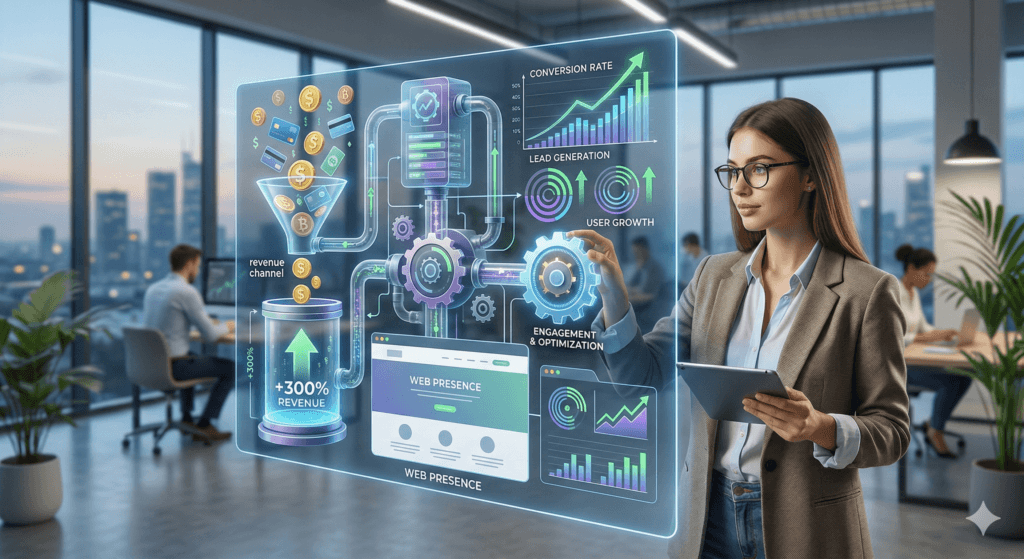
A real website growth strategy changes that completely. It treats the site as a system, not a collection of pages. Every part has a role. It guides attention, responds to behavior, adapts the experience, and ultimately drives a decision.
When those pieces are connected, something shifts. Growth stops depending on constant input and starts becoming more consistent, more measurable, and a lot more predictable.
That’s the difference between a website that supports the business… and one that actually drives it.
Why Do Most Websites Stall Out?
When you look closely, most underperforming websites follow the same pattern.
Traffic lands on pages that weren’t built with a clear next step in mind. Messaging stays the same no matter who the visitor is. Automation runs in the background, but it’s disconnected from what users are actually doing. CRM data exists, but it’s not influencing the experience.
Everything is technically there. It’s just not working together. So the outcome is predictable.
People visit, but don’t convert. Leads come in, but don’t progress. Sales teams follow up without context. Marketing keeps pushing traffic into a system that can’t absorb it.
It’s not a visibility issue. It’s a coordination issue. Without structure, attention gets lost. Without connection, intent goes cold. And without a system tying it all together, growth stays inconsistent no matter how much effort you put in.
If you’re generating traffic but can’t clearly connect it to predictable revenue, your website may be operating below its potential.
Schedule a Website Growth Audit with Cultura Interactive and uncover where your current system is leaking revenue.
The Shift: From Pages to Systems
Fixing this isn’t about redesigning a few pages or adding another tool. It’s about changing how you think about the website entirely. Instead of asking, “How does this page look?”
You start asking, “What role does this play in moving someone forward?”
That shift, from pages to systems is what turns a website into a revenue channel.
And when you break that system down, there are a few core components that show up every time.
1. Funnel Architecture: Give Users Direction
Most websites assume users will figure things out on their own. They won’t. People don’t arrive with unlimited time or patience. They scan, they evaluate quickly, and they either move forward or they leave.
A high-performing website removes that ambiguity. It creates a clear path from the first interaction to the moment of conversion and beyond.
That path usually follows a natural progression: awareness, engagement, consideration, conversion, and retention. Not as a theoretical model, but as a real, designed experience.
When that flow is missing, users drift. When it’s clear, they move with purpose.
2. Automation That Reacts to Behavior
Once the structure is in place, the next layer is responsiveness. Because traffic alone doesn’t create revenue. What happens after the visit?
Most automation setups are still static. They send the same messages, in the same order, regardless of what the user actually does. That’s where things break. A stronger approach is to let behavior drive the system.
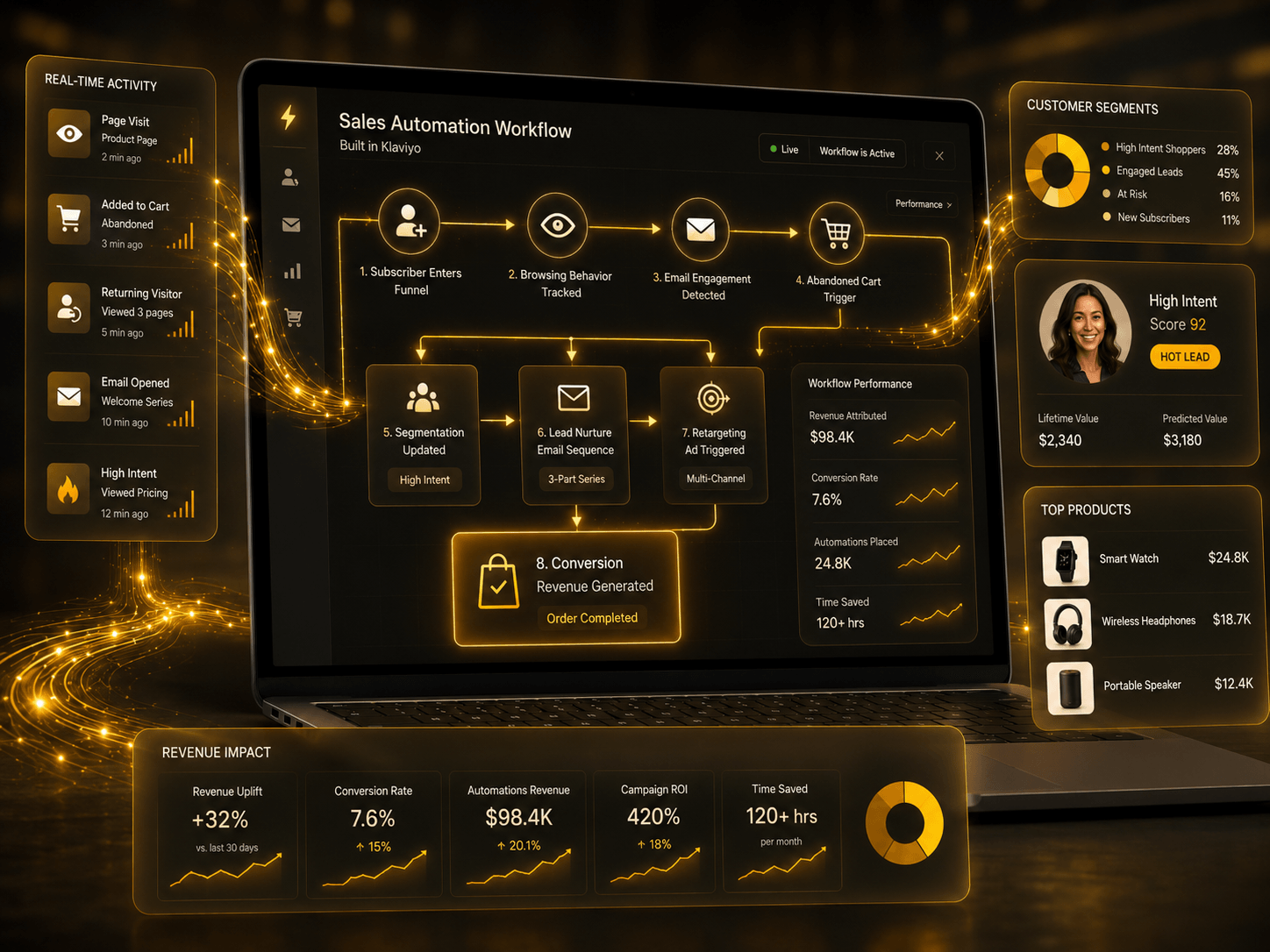
If someone abandons a cart, the follow-up happens immediately. If they engage with a specific piece of content, the next interaction reflects that interest. If they show strong buying intent, the system responds accordingly.
This is where automation stops being a background task and starts becoming part of the experience.
For B2B environments, this usually ties deeply into CRM workflows. For eCommerce, it shows up in timing, sequencing, and behavioral triggers.
When it’s working properly, it removes friction and shortens the path to conversion.
3. Personalization: Make the Experience Relevant
At some point, every team runs into the same realization. Not all visitors are the same. But the website treats them like they are. That’s where conversions start to plateau.
A new visitor needs context. A returning user needs momentum. A high-intent buyer needs clarity and reassurance.
When all three see the same message, you’re forcing them through an experience that doesn’t match where they are. Personalization solves that by adjusting the experience in real time.
It can be as simple as changing a call-to-action based on intent, or as advanced as dynamically adapting offers, messaging, and product recommendations based on behavior.
The goal isn’t complexity, It is relevance, and relevance is what moves people forward faster.
4. CRM Integration: Connect the Dots
This is where most systems quietly fall apart.
The website collects data. Marketing runs campaigns. Sales manages conversations. But none of those pieces are fully connected, so every team operates with partial visibility.
Leads get passed without context. Follow-ups miss the moment. Opportunities slip because no one has the full picture.
When CRM and website behavior are properly connected, that changes quickly. Now you can see how someone engaged before they ever spoke to sales. You can prioritize leads based on actual intent. You can trigger follow-ups at the right time instead of relying on guesswork.
At that point, marketing and sales stop operating as separate functions. They start operating as one system.
5. Continuous Optimization: Where Growth Compounds
Even with everything in place, no system is perfect on day one. The difference is, now you have something you can improve.
High-performing teams are constantly refining:
- How pages are structured
- How offers are positioned
- How funnels progress
- How and when automation triggers
But the real advantage comes from knowing what to optimize. Not based on opinions. Based on revenue.
Which channels are actually converting?
Which journeys lead to higher-value customers?
Where are users dropping off?
When you can answer those questions clearly, optimization stops being reactive. It becomes intentional, and over time, those small improvements start to compound.
The Infrastructure Behind It All
At some point, this stops being about individual improvements.
You can have a clean funnel, solid automation, even some level of personalization and still feel like things aren’t compounding the way they should. That’s usually a sign that the system isn’t fully connected.
Because none of these elements create real leverage on their own. They only start to matter when data flows between them when what a user does in one place actually influences what happens next.
That’s the role of infrastructure.
Not more tools, but a layer that connects everything: behavior on the site, CRM data, campaign performance, purchase history.
And once that context exists, the system can start making better decisions.
The Technology Behind Advanced Personalization
Personalization at scale isn’t powered by plugins. It’s powered by data infrastructure. Modern growth-focused companies use Customer Data Platforms (CDPs) like Synerise or Klaviyo to orchestrate real-time user experiences.
Centralize customer data across channels
Track behavioral signals in real time
Build dynamic audience segments
Trigger automated decision models
Deliver AI-driven content personalization
Synchronize website activity with marketing/sales systems
From Reactive to Predictive
You can usually tell when a system is reactive. It waits. A user visits the pricing page… nothing happens. They come back a second time… still nothing. Maybe they fill out a form, maybe they don’t and only then does the system respond.
By that point, you’re already late. Because the most important signals don’t happen at the moment of conversion. They happen before that quietly, in the way people browse, hesitate, compare, and come back.
That’s what most setups miss. When your data is fragmented, you only see isolated actions. A click here, a visit there. Nothing that feels meaningful on its own.
But once everything is connected, those small actions start to tell a story. You notice patterns.
Someone who visits the same product three times in two days.
Someone who reads your pricing page, then disappears.
Someone who engages deeply with a specific category but never takes the next step.
Individually, those signals don’t trigger anything. Together, they show intent. And that’s where the shift happens.
Instead of waiting for a user to raise their hand, you start recognizing when they’re close. When they’re unsure. When they’re about to leave. So the system doesn’t just respond it steps in at the right moment.
It surfaces the right message.
It adjusts the experience.
It removes friction before it becomes a reason to drop off.
Now you’re not reacting to behavior after the fact. You’re guiding it while it’s happening. And that’s when the website stops being passive.
It starts behaving more like a good salesperson, paying attention, reading the situation, and knowing when to step in and when to stay out of the way.
That’s the real shift.
Not just faster reactions.
Better timing. Better judgment. Better outcomes.
A Simple Reality Check
At this point, the question isn’t whether you have the right pieces. It’s whether those pieces are actually working together.
Because that’s where most setups fall short not in capability, but in connection.
If you want to pressure-test it, step back and look at your system as a whole:
Are users moving through a defined journey, or figuring it out on their own?
Does behavior influence what happens next, or does everyone get the same experience?
Is your CRM informing decisions in real time, or just storing data?
Can you clearly trace how interactions turn into revenue?
If those answers feel disconnected, that’s the issue. Not performance. Not effort. Structure.
What This Actually Means for Growth
When everything clicks, the shift is obvious. You stop thinking in terms of pages, campaigns, or isolated improvements. You start thinking in terms of systems that guide behavior and produce outcomes.
Traffic becomes input, not the goal.
Automation becomes responsive, not scheduled.
Personalization becomes relevant, not cosmetic.
Data becomes actionable, not just visible.
And most importantly, growth stops depending on constant intervention. Because now the system is doing part of the work.
That’s what turns a website into a revenue channel.
Not more activity.
Better coordination.
Ready to Turn Your Website Into a Revenue Channel?
If your current setup isn’t producing predictable revenue, it’s time to redesign the architecture behind it.
Schedule Your Growth Strategy Consultation with Cultura Interactive
Let’s build a website that drives revenue not just traffic.